Valve Hardware Day 2006

Collapse
This topic is closed.
X
X
 
  • Time
  • Show
Clear All
new posts
  • CSN NewsBot

    #1

    Valve Hardware Day 2006

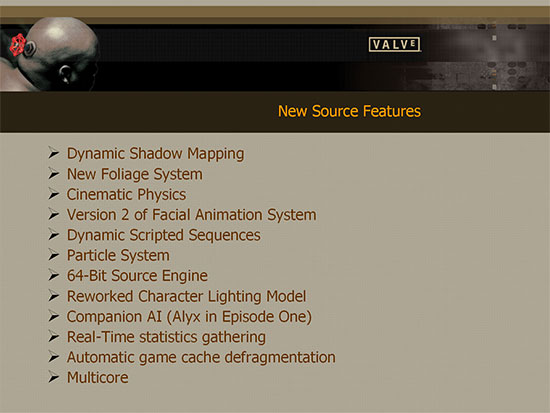
    The latest to gaze upon the future of the Source engine is none other than AnandTech. Their massive, 10 page preview dives deeper into the benefits of multi-core support being implemented into the Source engine. They also take a rather nice look at various benchmarks between current generation systems and future multi-core systems.
    The good news is that it appears Valve and others will be able to make good use of multi-core architectures in the near future. How much those improvements will really affect the gameplay remains to be seen. In the short term, at least, it appears that most of the changes will be cosmetic in nature. After all, there are still a lot of single core processors out there, and you don't want to cut off a huge portion of your target market by requiring multi-core processors in order to properly experience a game. Valve is looking to offer equivalent results regardless of the number of cores for now, but the presentation will be different. Some effects will need to be scaled down, but the overall game should stay consistent. At some point, of course, we will likely see the transition made to requiring dual core or even multi-core processors in order to run the latest games.
    Make sure you pay careful attention to the benchmarks near the end of the preview. Quad-core systems seem to be the way to go, if you can afford the $1,000 or so that they're going to cost. That's not to say that dual-core systems are obsolete already. They still have plenty of life in them for quite some time to come.


    The "pretty but dumb era" is coming to a close, at least according to a line on one of the slides presented by Valve. What this means, is that there will be a major refocus on improving more than just the graphics in the future. More advance AI will come about and will advance at a pace that is equal to the advances in graphics. Speaking of which, there's a nice mention of some of the planned graphical updates right here. Enjoy!
  • FLeK0

    #2
    They called the hl2 AI advanced too.

    Comment

    • DaRk-AnGeL

      #3
      Exactly.... Let's hope they actually mean it this time :)


      I'm tired of seeing AI just stand and look at me or charge headfirst into a hail of bullets :P

      Comment

      • brains

        #4
        I think a major point that was touched on in this article was that the focus for the last few years was primarily on graphical feats, not core gameplay or advanced A.I., with few exceptions, and that the reason for this was limited CPU growth vs. rapid GPU growth. Now that the CPU power is becoming drastically more available on a wide scale, hopefully more developers will take advantage of it, so that we can have games that are more than just 'pretty but dumb.'


        Also, snarks finally make a debut on Source, which is good news for everyone :P

        Comment

        • -:Nighthawk:-

          #5
          When the HL2 AI was referred to as "advanced" in the past, it was compared to the original HL AI code (which was, by the standards of its day, also very advanced). I'm sure all of us can agree that there was a tangible improvement in how squads fought alongside you in HL2 than, say, the occasional lone Barney escort in the original.


          I read both articles (or had Microsoft Sam read them to me in his delightful voice while I made breakfast, haha) and I must say, I find this tech to be by far the most exciting development I've come across for quite a while. Every hardware benchmark I see on other sites from time to time that features HL2 alongside other games tends to show almost identical performance for HL2 at 1024x768 as 1600x1200, due to its extreme processor dependence.


          Particle systems are cool and all, and I look forward to some of that eye-candy, but the physics and AI applications are definitely far more interesting to me. Rome: Total War was the first time I had a feeling of how cool the idea of a massive playing field filled with combat can be, and a few other RTS games have duplicated that since... but I have yet to see that kind of scale in the FPS department. That is a cool idea that I really look forward to seeing.


          Also the interaction between objects... I was glad to see the addition of weapons strapped to the backs of players in CS:S, but how much cooler would it look if the game actually took the time to have a real dynamic strap on every weapon, and actually see players sling one back and grab the pistol from their holster? Sure, we're talking about a visual effect, but it's the little things (like objects appearing out of nowhere) that rip you back out of the immersion of a game as your mind says "wait a minute, that object just appeared out of nowhere, and the other object just disappeared."


          Anyway, it's really exciting stuff to look forward to. My personal prediction is that we've got two years before we see "dual-core or better" system specs on any notable number of top-end games, but only time will tell. For now, though, even running a listenserver while having a LAN party with your buddies sounds like it will have far better performance than it does now; usually we begin them with the "okay, who's got the best processor?" discussion, and it's nice to think of a multicore processor hosting and seeing absolutely no hit in FPS. :)


          Great article, definitely worth the read. Or the listen.

          Comment

          Working...